*SWANA (Southwest Asia & North Africa) is used as replacement language for “MENA” (Middle East & North Africa). MENA is an orientalist, colonial, and geographically inaccurate acronym to refer to the countries and ethnic & cultural groups present across North Africa and Southwest Asia.
Mashallah Night, March 2019
I don’t really attend conferences unless I have to for work. I am not really about the linkedin-handshaking-business-card-sharing-white-networking events, especially not to sell myself, my art, or my ideas among a sea of other people doing the exact same thing. They aren’t on my radar, I don’t know the who’s-who, and frankly don’t really care. I go to comic-con, PAX, and other nerdy conventions to enjoy myself, play some games, read some good stories, and maybe leave with a few ideas for cosplays or other projects. The only “real” conference I’ve attended off the clock was when Jake’s sister gifted us tickets to AWP in 2019.
For the uninitiated (as I was at the time), the Association of Writers & Writing Programs (AWP) is a massive literary organization that hosts one of the largest writing conventions annually in North America. I am talking almost a thousand exhibitors at this conference type massive. I didn’t know what it was but was excited at the prospect of going and finding new journals to maybe submit my poetry to or some cool new writers to follow. I was a 19 year old emerging poet and writer with no idea or intention of taking my writing more seriously than this website.
I left AWP with the same impression I got from the USAID conferences (that convinced me to switch my career path away from politics) when I was studying abroad in Amman, Jordan: there’s a lot of white people here that don’t look like me talking about shit that doesn’t actually matter to me despite all of the other really important things they could be talking about and are very excited to meet famous people here that I don’t know. It was just so massive, so professional, and so stuffy that it was hard to discern where to even start. Panels? Readings? Workshops? Research all the authors and pick one to go meet? Just go buy a bunch of shit and see who seems interesting? I wasn’t even old enough to attend most of the off-site events at nearby bars after-conference-hours to mingle with folks.
Admittedly, I don’t remember much from the conference because on the second or third day my 1998 Honda Civic was stolen from the hotel parking garage (apparently the fifth one that week from that garage according to the cop, I definitely remember that part). Of course something like this would happen on my first multi-day trip away from home after being estranged from my family and kind of on my own for the first time. I spent all my savings on that car after being kicked out of my family’s house the year before. It had a lot of my life in it, and frankly it was all I really had at the time that I could truly and wholly call “mine.”
I remember being so upset knowing that if I were still in contact with my family, my dad, uncle, and siblings would’ve driven down as soon as they found out to make sure I was okay and see how they could help. How was I going to get home after the conference if I didn’t find the car? How was I going to make the 40 minute commute to work on Monday from Jake’s parents’ house? Would I ever get my photos, CDs, and journals back from the glovebox? How was I going to pay for the fees insurance wouldn’t cover for the towing of my car when it was eventually found (absolutely wrecked and gutted)? Why the fuck do the tow-yards jack up the prices and somehow both them and the fucking City of Portland make money out of my misfortune? It was worse that Jake’s family didn’t seem to care or worry too much at all. I remember them texting us back, joking about me being so scared and upset about it all with no useful support whatsoever. I digress. An essay for another time. I was stressed and sad, you get it. Left me with a pretty biased recollection of the whole thing.
The only thing of value I left AWP with came from an off-site event hosted at a strange, pop-up library 5 miles into town the day before the conference even started called Mashallah Night. The lineup of Team Mashallah was nothing short of legendary: Hanif Abdurraqib, Kaveh Akbar, Fatimah Asghar, Safia Elhillo, and Angel Nafis. The best part about this? I only went because I recognized Kaveh’s name, barely. I learned about Kaveh Akbar, an Iranian-American poet, earlier that year when he was booked at my university to do a reading from Calling a Wolf a Wolf. He was the first poet I had ever seen blend Islamic/Arabic words into English writing and has been a guide to discovering myself as a writer ever since. Behold me fangirling over Fatimah (photos are pink as Jake was just starting to get into his infrared photography, I believe this was his first spin with it, actually) and a bonus baby picture of me and Jake from the conference.

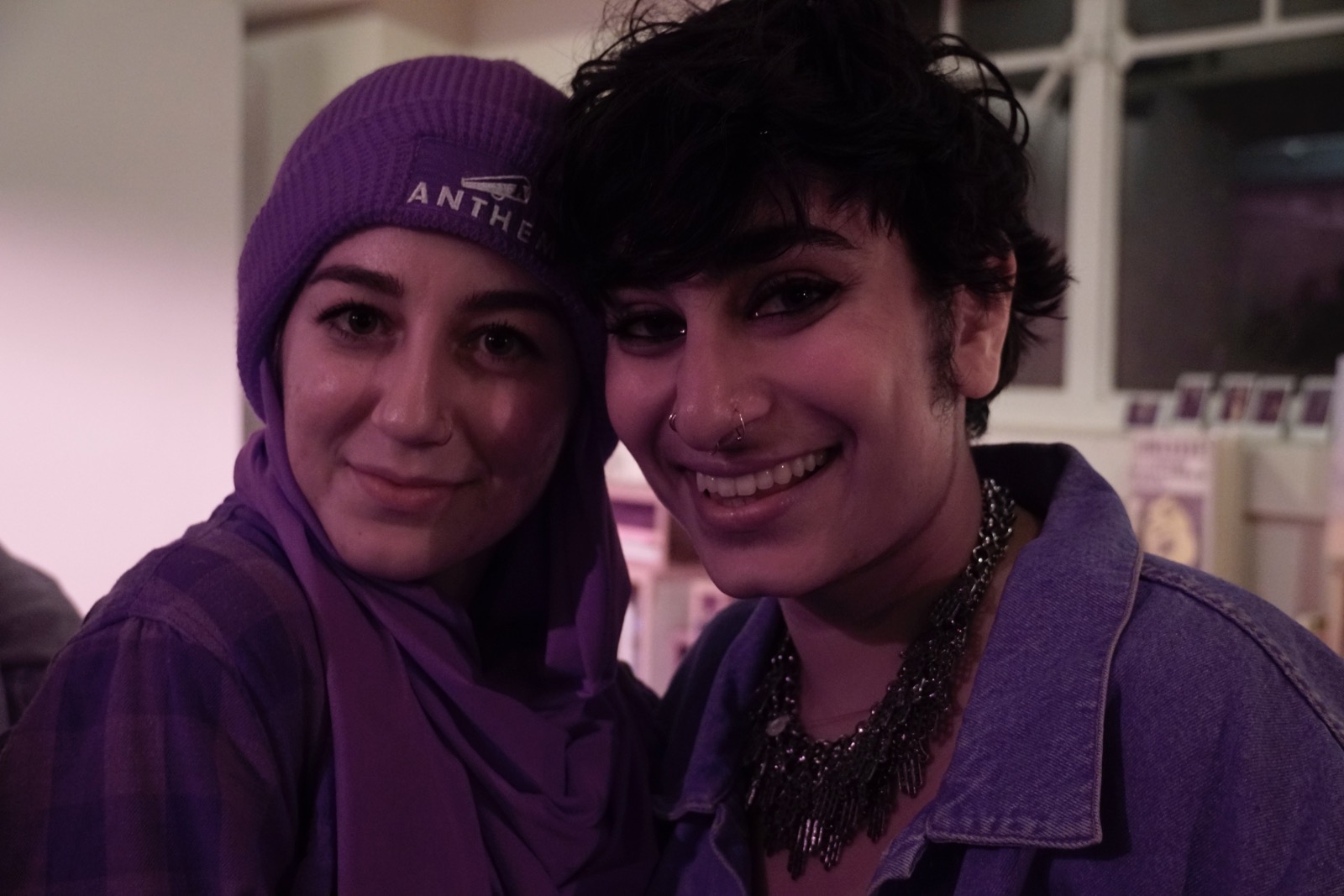
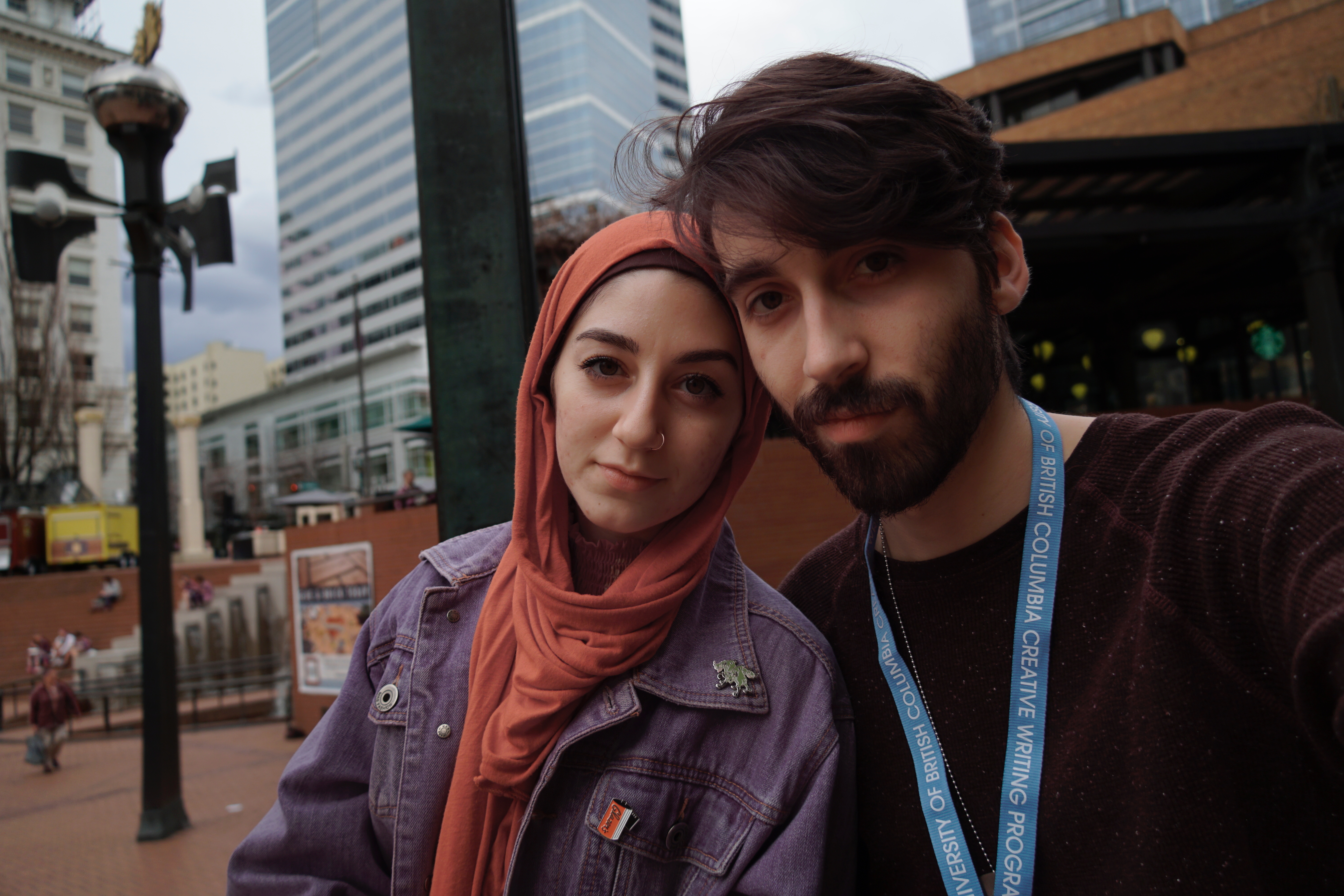
That night introduced me to the first five SWANA writers who wrote about shit that I cared about, looked like me, were queer and alternative and actually seemed easy to talk to and follow. For the first time, I saw a future where my writing ended up in more than university literary journals as a token diversity piece. I saw a future as a writer and an artist inspired by other SWANA creatives. I am forever grateful for catching that reading in 2019 so that those five incredible humans could open up what I thought was the small, extremely white, sterile, and seemingly inaccessible world of writing.
RAWIFest, October 2025
Earlier this year, my friend Ariel introduced me to RAWI: The Radius of Arab American Writers. My first thought was how bizarre it was that something with “Arab American Writer” in the name had completely escaped my knowledge up until this point. Even more bizarre, this organization has existed since the 90s and was originally chaired by Etel Adnan, legendary Lebanese-American writer and artist. Why did it not occur to me to look for an organization like this? Why did it feel impossible to even imagine? Why has it always felt so novel finding other SWANA writers, why have none of the writing teachers, professors, bookstores, librarians, publishing houses, why had no one told me about this? How exciting! And also– damn it was hard not feeling out of the loop, again.
A quick search informed me that RAWI hosts a biannual event called RAWIFest. Every other year since the 90s, RAWI has partnered with sibling-organization Mizna (another organization that centers Arab-American and SWANA stories that I had no idea existed) to put on a multi-day conference filled with panelists, artists, workshops, readings, discussions, screenings, all by SWANA authors, artists, and creatives. Have I ever been to a conference on my own, out of state, ever? No. Do I know literally any other human who would want to attend this with me? Nope. Am I professional writer with anything published or anything interesting in the works? Not really. Do I have a writing-related day job, like do I work in comms somewhere or edit a journal? Nope, again. Did I make a very uncharacteristically-impulsive decision to register for this conference, buy an airplane ticket, and book a room in Houston, Texas? You bet your ass, I did.
So I rolled up to Houston like I did to AWP in 2019: cautiously optimistic. I had no idea what I was getting into but, hey, at the very least maybe I can make some friends? I had a few friends send me well-wishes of safe travel, knowing that Texas had just passed the anti-trans SB 8 and ICE was out in force. It felt like a particularly unsafe time to visit Texas alone for the first time. The whiteness of the Pacific Northwest had never felt more blinding than landing in Texas fully expecting a sea of people who were the epitome of the word “Republican,” only to be met with the reality that Houston is one of the most diverse cities in the entire nation with over 100 different languages spoken. Washington State could never. The Lyft driver who picked me up from the airport had actually informed me of this.
He was an Egyptian immigrant and an English teacher for bilingual students near the University of Houston, where I’d be staying. I told him about the conference and he was excited to hear that I was attending and expressed he was proud I could still speak the language. He was the first person I had actually spoken Arabic with (that wasn’t my parents) in probably three or four years. Despite stumbling through the incorrect conjugation of verb tenses, he understood me. He said I sounded a lot like his nieces, with English prepositions dotting my Arabic sentences and Arabic filler words sliding into my English sentences. I had to listen really intently to understand his Egyptian dialect and was slow to respond to him, but I remember so clearly how it lit up a part of me that had been desperately wanting to come out.
Equipped with punk free Palestine stickers I designed and printed an hour before heading to the airport and the encouragement from my Lyft driver the day before, I walked in on that first day feeling ready. What I was not ready for was being met with several authors who I knew and whose books I owned on my bookshelf greeting me at registration. Or how everyone I spoke with asked me what I have written. Or how everyone else had their MFAs, PhDs, two or three books out, etc. etc. etc.
Those three days were so filled with joy and learning and earnest relationship building, that it would take me a good long while to parse through all my notes and thoughts to write something comprehensive about the experience. What I will share, though, is that the first time someone introduced themselves to me on the first day and asked if I was a writer and what I wrote, I answered with something along the lines of “oh, no, not really. I write for fun, have for a long time, but I just work for the government. I just like writing and wanted to make some writer friends.” The last time someone was introducing themselves on the last day, I distinctly remember answering, “yes. I write poetry and speculative short fiction and love writing around ecological, nature-based, and place-based themes. I have a few chapbooks I am hoping to publish soon and have started my first spec fic novel.”
I started the conference as someone who liked writing and ended the conference as a writer. I met so many amazing people and made so many friends. So many folks who were much older than me who shared incredible bits of advice and mentorship over the course of the weekend. I got to sit in on panels and engage in discussion about things I not only knew about, but felt extremely confident in. I was in spaces where I could weigh in on community building, organizing for resilience, and on staying hopeful in dark times. I was in spaces where I could grieve with others about Palestine, about the suffering of our people, about it all. I spoke Arabic with other writers who played DnD and wrote fantasy, who listened to metal music and went to shows. I got to talk to other Muslims about our spirituality, books written about how our faith connects to nature, and exchange different ways that we practice and observe Islam. Just a year ago, I would never have imagined a space like this existed, let alone a space that I could access and be welcomed in.
Not only was I welcomed, but I felt seen. Certainly seen and welcomed enough to sign up for the open-mic performance on the last day, despite not having performed in like three years.
It wasn’t perfect, but it was fun and validating. I had so many people ask where they could get my poetry books or read more of my writing. I have never felt more energized to take my writing seriously than after attending RAWIFest. I didn’t feel like an imposter anymore, rather someone who knew they had something to say that was worth listening to.
Reading List – SWANA Writers
Definitely take a moment to check out the official reading list of the writers who attended and were featured at RAWIFest 2025. Especially works from the keynote speakers, Noor Naga, author of If an Egyptian Cannot Speak English, and the one and only Fady Joudah, who most recently published […].
Writing Workshop at Blue Cactus Press, November 2025
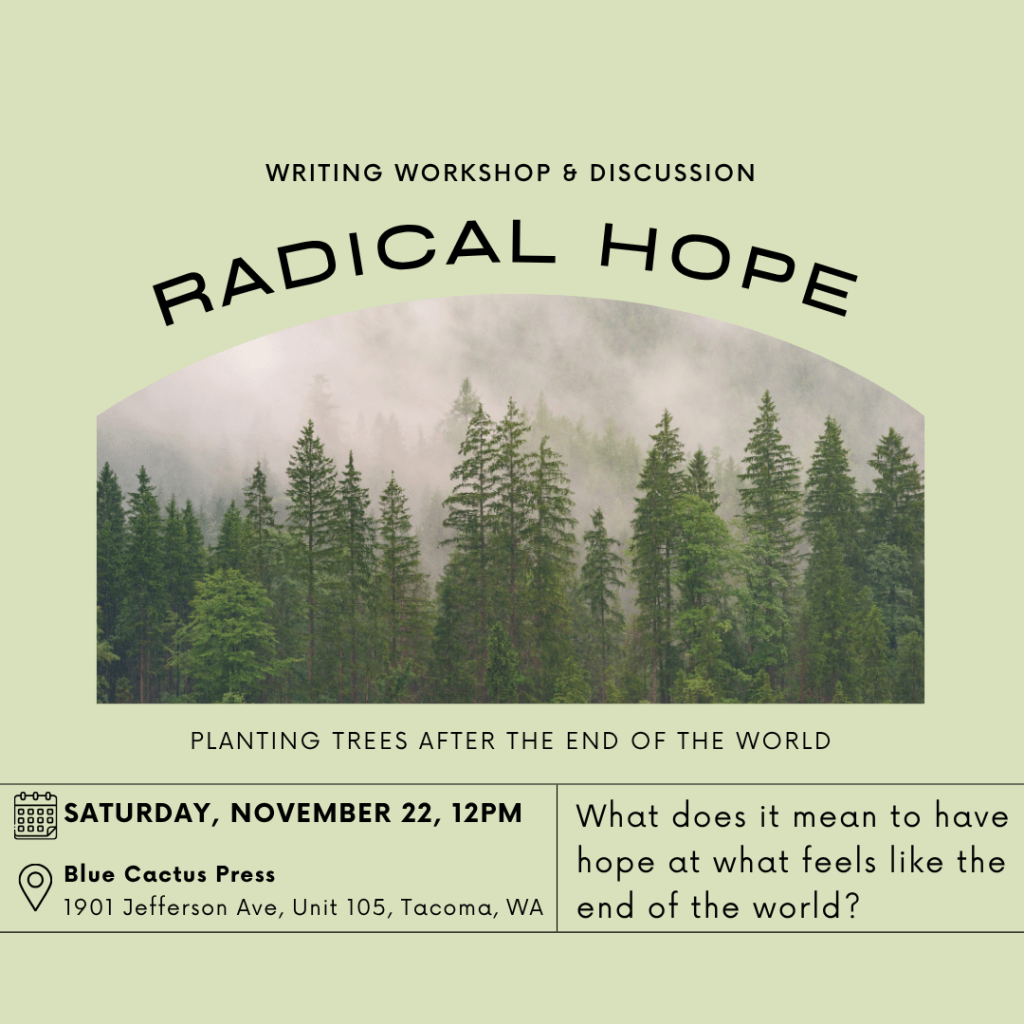
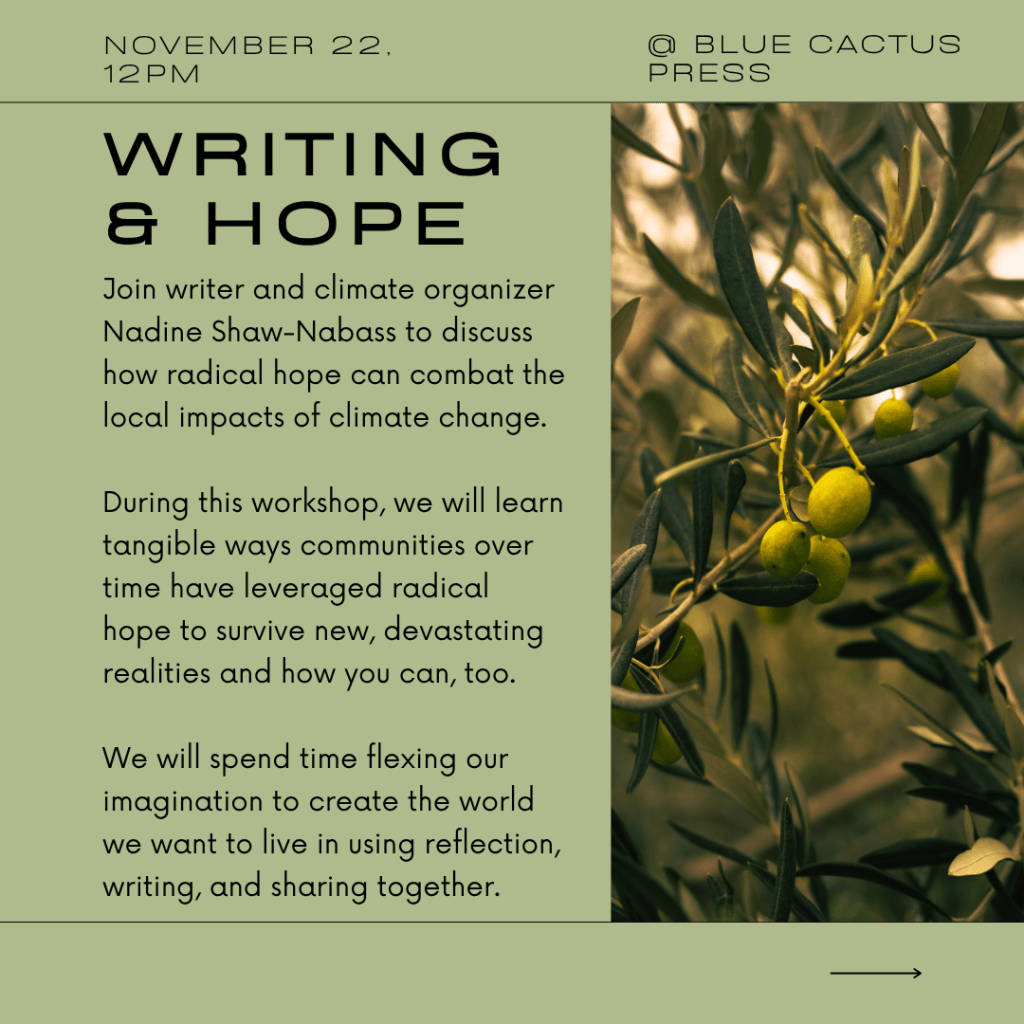
All that to say– I hosted my first ever writing workshop last month at the independent publisher (and dream home for my poetry) Blue Cactus Press in Tacoma. For 90 minutes, I held about 20 or so people captive to imagine a better world in a workshop that was a synthesis of my graduate research, love for speculative fiction and solarpunk writing, and recent endeavor into climate organizing. I talked about the workshop while I was at RAWIFest, given I was preparing for it, and lots of folks expressed interest in attending a virtual version. I am really glad to share that the in-person event went phenomenal and I hope to host more workshops like this soon. Like I said, started this year liking writing. Ending this year as a writer. Turns out with the right support, it feels like you have something worth saying that people want to hear. This workshop was a fantastic way to send off a milestone of a year in terms of writing, art, and creativity. I can’t wait to see how 2026 kicks off. I hope you stick around to find out.

“Indigenous knowledge is not about the what, but the how. It is about process, not content. Your culture is not what your hands touch or make, it is what moves your hands.” – from Sand Talk: How Indigenous Thinking Can Save the World by Tyson Yunkaporta.
 So Nadine Writes
Leave a comment